Table of Contents
- Introduction: Why This Question Matters Today
- Understanding the Modern Learning Landscape
- How the Brain Learns: A Beginner-Friendly Overview
- What Happens in the Brain When You Read
- Focus and deep processing
- Language, memory, and imagination
- What Happens in the Brain When You Watch Videos
- Visual learning and cognitive load
- Attention, emotion, and retention
- Reading vs Watching Videos: A Side-by-Side Comparison
- When Reading Is More Effective
- When Watching Videos Works Better
- The Role of Attention Span and Distraction
- Learning Styles: Myth vs Reality
- Long-Term Brain Development and Mental Skills
- Common Mistakes People Make (and How to Avoid Them)
- Benefits of Combining Reading and Video Learning
- Practical, Safe Tips to Improve Brain Learning
- Long-Term Value for Students, Professionals, and Lifelong Learners
- Frequently Asked Questions (FAQs)
- Conclusion: Making the Smart Choice for Your Brain
1. Introduction:
Why This Question Matters Today
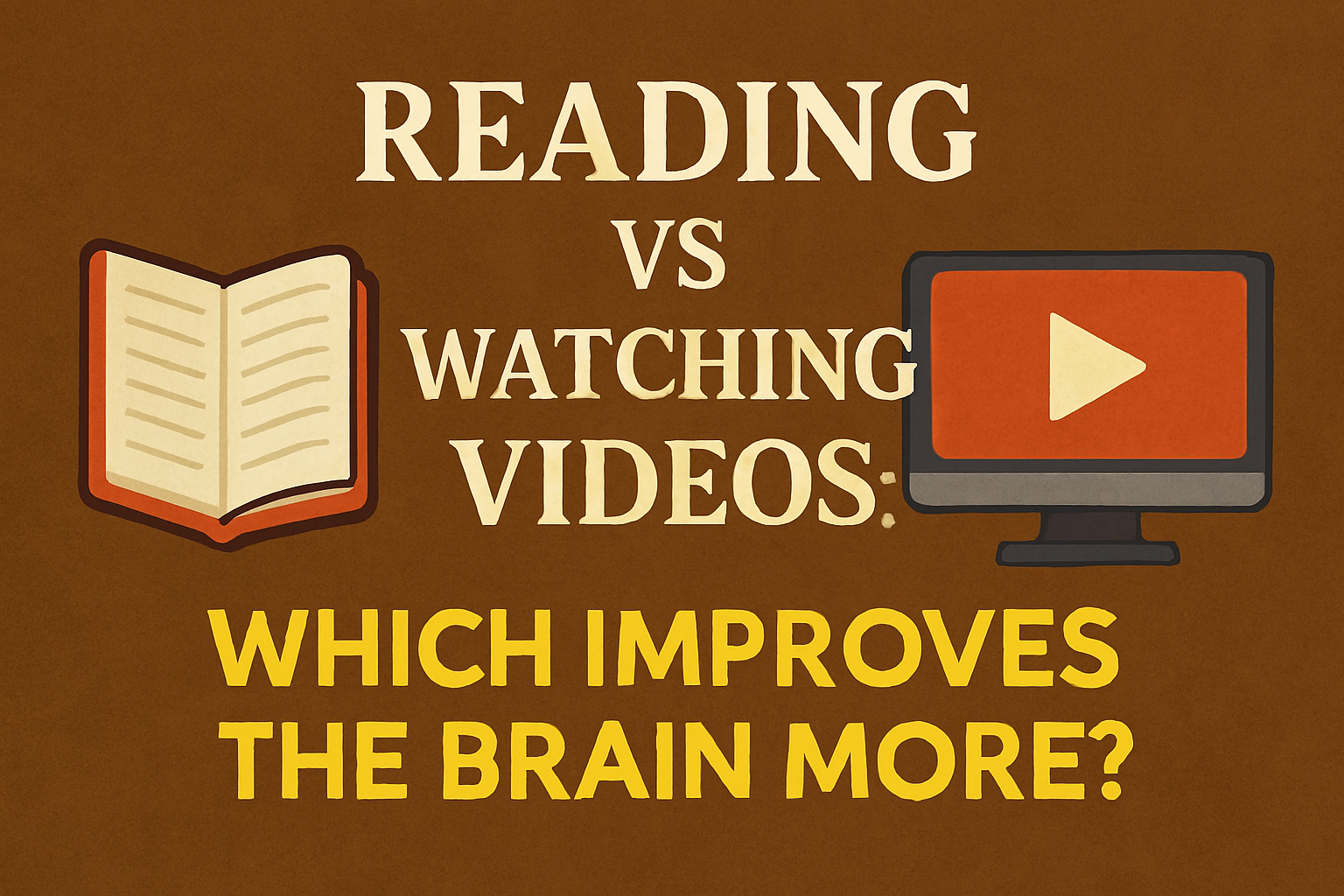
The question “Reading vs watching videos: which improves the brain more?” has become increasingly important in today’s world—not because learning itself is new, but because how we learn has changed faster than at any other time in history. Just a few decades ago, reading was the primary gateway to knowledge. Books, textbooks, newspapers, and written notes were unavoidable if someone wanted to learn deeply. Today, however, videos dominate the digital space. Tutorials, explanations, lessons, and even summaries of books are now available in video form, often lasting only a few minutes.
This shift has quietly changed how people interact with information, how long they focus, and how deeply they understand what they learn. As a result, many people—students, professionals, parents, and lifelong learners—are beginning to question whether these new learning habits are actually helping or harming their cognitive abilities over time.
The importance of this question lies in long-term brain development, not short-term convenience.
Modern life encourages speed. People want quick answers, fast explanations, and easy consumption. Videos naturally fit this lifestyle. They are engaging, visually appealing, and require less effort to begin. Reading, on the other hand, demands patience, focus, and mental effort—qualities that are becoming harder to maintain in a world full of notifications, short clips, and constant digital stimulation.
This creates a real dilemma. If videos are easier and more enjoyable, does that mean they are better for learning? Or does the mental effort required by reading provide deeper benefits for the brain that videos cannot fully replace?
This question matters today because learning habits shape the brain over time. The brain adapts to what it does repeatedly. If learning becomes mostly passive, fast, and surface-level, the brain may become efficient at scanning and reacting but weaker at sustained attention, deep reasoning, and critical thinking. On the other hand, if learning remains effort-based and reflective, the brain continues to strengthen skills related to focus, comprehension, and analysis.
Another reason this topic is important is the impact on education and self-improvement. Students often rely heavily on video explanations instead of textbooks. Professionals may prefer short video summaries over detailed reports. Even casual learners may watch content without ever reading supporting material. While this approach can feel productive, it raises an important question: are people truly understanding, or just consuming information?
There is also a growing concern about attention span. Many people report difficulty concentrating on long texts, even when the topic interests them. This is not necessarily a personal failure; it reflects how digital environments shape behavior. Understanding whether reading or watching videos supports better brain function can help individuals rebuild focus intentionally rather than passively adapting to trends.
Parents and educators are also paying attention to this question. Children are growing up in a world where screens are everywhere. Knowing whether reading or video-based learning contributes more positively to cognitive development helps guide healthier learning habits early in life—without rejecting technology altogether.
Importantly, this question is not about choosing one method and rejecting the other. It is about making informed decisions. Videos are not inherently bad, and reading is not automatically superior in every situation. The real issue is understanding what each method does to the brain, when it is most effective, and how it should be used responsibly.
In addition, this topic matters because misinformation is common. Many articles exaggerate claims, suggesting that one method is “destroying the brain” or that the other is a “guaranteed way to become smarter.” Such statements are misleading and unhelpful. People need clear, balanced, and evidence-based explanations that respect the complexity of learning rather than oversimplifying it.
Finally, this question matters because learning is no longer limited to classrooms. People learn continuously—through articles, videos, courses, and online content—often without realizing they are shaping their mental habits. Understanding the cognitive effects of reading versus watching videos empowers individuals to take control of their learning instead of letting algorithms decide for them.
In short, this question matters today because learning methods influence how the brain thinks, focuses, remembers, and grows. In a world where information is abundant but attention is limited, knowing how to learn effectively is not just useful—it is essential.
2. Understanding the Modern Learning Landscape
Learning methods have changed dramatically over the past two decades.
In the past:
- Books, newspapers, and classrooms were the main sources of knowledge.
- Learning required sustained attention and patience.
Today:
- Videos, short clips, and animations dominate online platforms.
- Information is faster, more visual, and often shorter.
Both reading and watching videos are now part of daily life. However, they engage the brain in different ways. Understanding these differences helps you use each method more effectively instead of relying on habit or convenience.
3. How the Brain Learns: A Beginner-Friendly Overview
Before comparing reading and videos, it helps to understand how learning works in the brain—in simple terms.
Learning involves:
- Attention: Focusing on information
- Processing: Making sense of what you see or read
- Memory: Storing information for later use
- Application: Using what you learned
The brain learns best when:
- Attention is active, not passive
- Information is processed deeply
- The learner is mentally engaged
Different learning formats influence these processes in different ways. Reading and watching videos are not equal in how they stimulate attention, memory, and understanding.
4. What Happens in the Brain When You Read
Reading is an active mental process. Even simple reading requires multiple areas of the brain to work together.
Focus and Deep Processing
When you read:
- Your brain decodes symbols (letters and words)
- You mentally construct meaning
- You imagine concepts, scenes, or ideas
Unlike videos, text does not provide images or sounds automatically. Your brain must create them, which increases mental effort.
This effort:
- Strengthens concentration
- Encourages deeper thinking
- Improves the ability to analyze information
Language, Memory, and Imagination
Reading directly supports:
- Vocabulary development
- Sentence comprehension
- Long-term memory formation
It also activates imagination. When you read a description, your brain fills in the details. This mental activity strengthens neural connections related to creativity and abstract thinking.
In simple terms, reading makes your brain work harder, and that work can be beneficial when done regularly.
5. What Happens in the Brain When You Watch Videos
Watching videos is a more sensory-rich experience. It combines images, sound, movement, and sometimes text.
Visual Learning and Cognitive Load
Videos:
- Deliver information quickly
- Reduce the need for imagination
- Provide ready-made visuals
This can be helpful for understanding:
- Demonstrations
- Physical processes
- Step-by-step actions
However, because visuals and sounds are provided, the brain may process information more passively, especially if the video is fast-paced or entertaining.
Attention, Emotion, and Retention
Videos often:
- Capture attention easily
- Trigger emotional responses
- Feel engaging and effortless
This engagement can improve short-term understanding, but it does not always lead to deep learning unless the viewer is actively thinking, pausing, or reflecting.
6. Reading vs Watching Videos: A Side-by-Side Comparison
| Aspect | Reading | Watching Videos |
|---|---|---|
| Mental effort | High | Moderate to low |
| Attention required | Active | Often passive |
| Speed of learning | Slower | Faster |
| Depth of understanding | Deeper | Can be shallow |
| Imagination use | High | Low |
| Best for | Complex ideas, critical thinking | Visual demonstrations, overviews |
This comparison shows that neither method is universally better. The value depends on how and why you are learning.
7. When Reading Is More Effective
Reading tends to be more effective when the goal is deep understanding.
Reading is especially useful for:
- Complex concepts
- Abstract ideas
- Critical analysis
- Language learning
- Long-term memory building
Examples include:
- Studying theory
- Learning new terminology
- Developing reasoning skills
- Improving writing and communication
Because reading requires sustained focus, it trains the brain to resist distraction—an increasingly valuable skill.
8. When Watching Videos Works Better
Videos excel in situations where visuals matter.
Watching videos is effective for:
- Learning physical skills
- Understanding processes
- Seeing real-world examples
- Getting quick introductions to topics
Examples include:
- How-to demonstrations
- Visual explanations
- Observational learning
Videos can lower the barrier to learning, especially for beginners who may feel overwhelmed by dense text.
9. The Role of Attention Span and Distraction
One major factor in this debate is attention span.
Reading:
- Trains sustained attention
- Encourages slower, deeper focus
- Requires effort to stay engaged
Videos:
- Are often optimized for quick attention
- Can encourage constant stimulation
- May reduce tolerance for slow thinking
Excessive reliance on fast-paced videos can make it harder to concentrate on tasks that require patience, such as reading long texts or solving complex problems.
10. Learning Styles: Myth vs Reality
Many people believe they are “visual learners” or “reading learners.” While preferences exist, research suggests that learning styles are often overstated.
What matters more is:
- The nature of the material
- The learning goal
- The level of engagement
Instead of choosing one format permanently, effective learners adapt their approach based on context.
11. Long-Term Brain Development and Mental Skills
Over time, learning habits shape the brain.
Regular reading supports:
- Analytical thinking
- Verbal intelligence
- Mental endurance
Frequent video learning supports:
- Visual recognition
- Pattern identification
- Rapid information intake
For balanced brain development, both forms can play a role—but reading is particularly important for maintaining deep cognitive skills.
12. Common Mistakes People Make (and How to Avoid Them)
Mistake 1: Only Watching, Never Reflecting
Solution: Pause videos and summarize what you learned.
Mistake 2: Skimming Text Without Understanding
Solution: Read slowly and revisit difficult sections.
Mistake 3: Choosing Convenience Over Purpose
Solution: Match the format to your learning goal.
Mistake 4: Multitasking While Learning
Solution: Focus on one learning activity at a time.
13. Benefits of Combining Reading and Video Learning
The most effective approach is often a combination.
A smart strategy:
- Watch a video for overview and context
- Read for depth and detail
- Take notes to reinforce memory
This method engages multiple brain systems and improves understanding and retention.
14. Practical, Safe Tips to Improve Brain Learning
- Set specific learning goals
- Alternate between reading and videos
- Take short notes in your own words
- Review what you learned after a session
- Reduce background distractions
These habits support healthy, effective learning without relying on any single format.
15. Long-Term Value for Students, Professionals, and Lifelong Learners
For students:
- Reading builds academic strength
- Videos clarify difficult concepts
For professionals:
- Reading improves decision-making
- Videos help with skill refreshers
For lifelong learners:
- Reading keeps the mind sharp
- Videos keep learning accessible and enjoyable
Consistency matters more than format.
16. Frequently Asked Questions (FAQs)
Is reading better than watching videos for the brain?
Reading generally promotes deeper cognitive processing, but videos are useful for visual understanding. Both have value depending on purpose.
Do videos make learning lazy?
Not necessarily. Passive watching can reduce effort, but active viewing with reflection can still be effective.
Can videos replace reading?
Videos can complement reading, but they are not a complete replacement for developing deep thinking and language skills.
Is reading still important in the digital age?
Yes. Reading supports focus, comprehension, and long-term brain health.
How can I learn more effectively?
Use a balanced approach: videos for clarity, reading for depth, and active engagement for retention.
17. Conclusion: Making the Smart Choice for Your Brain
The question is not whether reading or watching videos is better in absolute terms. The real question is:
What kind of learning do you want to achieve?
Reading strengthens deep thinking, focus, and language skills. Watching videos enhances visual understanding and accessibility. Each method shapes the brain differently.
The most effective learners do not choose sides. They choose purpose, balance, and intentional learning.
By understanding how each method affects the brain, you can make smarter decisions that support long-term mental growth, clarity, and understanding—without relying on trends or shortcuts.
Internal link suggestions (anchor text only):